

25.06.2026
Beyond the Matrix: The reality of AI risk
As AI systems grow more capable, concern about the risks is growing. Even those closest to the technology cannot agree. Key leaders of the AI industry are divided and even the Pope has spoken out, calling for action to tackle the risks posed by the technology.
At this panel event, part of the University of York Festival of Ideas, researchers from the UKRI Centre for Doctoral Training in Safe AI (SAINTS) came together from across disciplines to debate those risks and how seriously we should take them. The event was chaired by Ibrahim Habli, SAINTS Director and Professor of Safety-Critical Systems at the University of York. Here are their key arguments.
Is the existential risk narrative a distraction?
Dr Jennifer Chubb – Responsible AI lead and Co-investigator for SAINTS
For Dr Jenn Chubb, SAINTS Responsible AI Lead and sociologist, existential risk isn’t primarily about rogue machines but about power. Specifically, it’s about a small elite controlling and shaping a technology whose values and biases are now embedded within it, and the systematic unravelling of the social fabric that follows.
Drawing on research she conducted in 2018, interviewing 50 experts on the future of AI, she noted that even then, many of those experts dismissed the dominant narratives (AI will either save humanity or destroy it) as a distraction from the everyday corrupting forces and harms of AI. Neither extreme, she argued, reflects what is actually happening, and neither is backed up by science. What’s striking is that eight years later, in 2026, the narratives haven’t particularly changed.
Notwithstanding the very real threat of environmental harm arising from AI, the polarised narratives that persist aren’t just unhelpful, she suggested, but somewhat paralysing. Nobody chose these futures. Instead, the tech oligarchy frame their prescribed imaginaries as necessary and inevitable, controlling public discourse and creating echo and epistemic chambers that reinforce their worldview through both material and algorithmic structures. The people who opened Pandora’s box position themselves as our saviours, suggesting that they are the only ones who can close it. In this way, these billionaires seek to make themselves indispensable to governments and their publics, and leverage our emotions, aware that they are a technopolitical driver that builds sociotechnical imaginaries so as to secure their own personal fortunes and futures. Meanwhile, it is the questionable values and biases of those elites which are precisely what has been used to train the AI systems now embedded in everyday life.
Dr Chubb also drew on her work with artists, to discuss the question of existential risk through the lens of what happens to art and creativity if we outsource them to machines. She has found a growing anxiety about the extent to which AI challenges creative practice. The dilution of culture could be for some less an existential risk in the traditional sense, but certainly challenge what makes life worth living.
There are grounds for optimism however, she believes. Across university campuses, creative communities and beyond, she described a growing backlash, and an ‘anti-AI sentiment’ emerging. Social movements show that those who care about love, art, the planet and humanity, can mobilise and push back against what they see as an existential threat.
The risk no one is talking about
Professor Tom Stoneham, SAINTS Training Co-Director and philosopher
For Professor Tom Stoneham, SAINTS Training Co-Director and philosopher, the more pressing danger isn’t that AI will kill people, it’s that it will quietly remove the conditions that make human life meaningful.
He built his argument around the philosopher Ivan Illich’s concept of “radical monopoly”, the point at which a technology becomes so embedded in daily life that opting out is effectively impossible. We are approaching that point with AI, he argued. Meta AI cannot be removed from WhatsApp. Copilot is being woven into Office 365. We don’t choose this technology: it is compulsory consumption.
This isn’t necessarily a bad thing, but he says, the word “intelligence”, as defined by the AI community, is problematic. Tracing it back to John McCarthy’s original definition – intelligence is the computational part of the ability to solve problems or reach goals – Professor Stoneham pointed to the values smuggled into that phrase. That faster, more powerful, efficient computers are better, that solving problems faster is better. These are values of perfectionism, competitiveness, high achievement, greed and power seeking, presented as technical properties, but they are also human values, which are being imposed on us. If AI becomes a radical monopoly built on those values, you won’t be able to choose to live in a world where they don’t dominate.
“If you end up in a world where those values associated with a certain sort of capitalist, entrepreneurialism, which we now identify with Silicon Valley, have dominated, that for me would be an existential risk for humanity.”
Professor Stoneham finished on a cautious note of optimism, referencing a recent Financial Times study that found 20% of Gen Z have never (knowingly) used AI. “Let’s make that 50%” of the next generation, he said.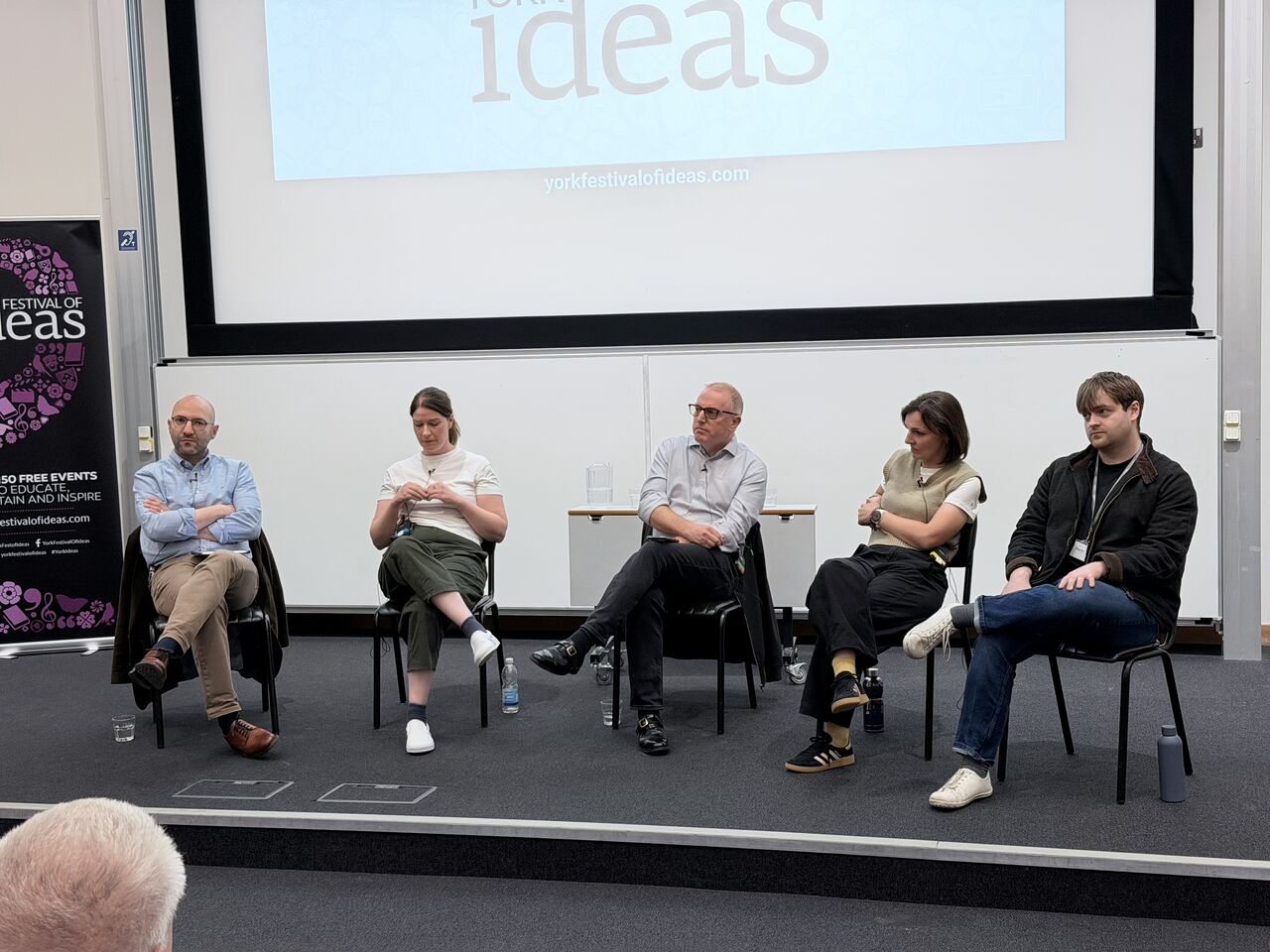
Scepticism about the doom narrative
Dr Laura Fearnley, SAINTS Research Co-Director
Dr Laura Fearnley positioned herself as the panel’s sceptic, not of AI’s capacity for harm, but of the way tech giants frame the existential risk debate.
She opened with Sam Altman, who in 2015 published a blog post describing the development of machine intelligence as probably the biggest threat to human existence, before, in 2016, going on to co-found OpenAI, suppress internal safety concerns, and scale the technology. Dr Fearnley referenced a recent interview with Altman in which he claimed that the probability of human extinction due to AI was around 2%. The interviewer pointed out that if the probability of a plane crashing were anywhere near 2%, entire fleets would be grounded. The gap between what Altman says and what he does, Dr Fearnley suggested, is a paradigm case of de-coupling. Tech companies promote the narrative of x-risk, but do the minimum (if not less) to ensure the safety of the systems they are deploying.
Her own position is that AI is impressive, but normal in the same way that electricity and the internet were impressive and transformative, without being supernatural or capable of transcending human intelligence. The existential risk narrative, she argued, is a trope that CEOs use to distract from the harms that are already here. She cited a recent study in which NHS patients with darker skin were being denied kidney transplants because an AI system was underestimating their kidney function. That, she said, is what real AI harm looks like.
Reframing AI as ordinary technology allows us to see those harms clearly and to do something about them. “It’s not the technology that’s the problem,” she said. “It’s the technology companies.” But the power to change that, she argued, doesn’t lie with CEOs. Technological integration does not happen in a vacuum, it is not simply created by inventors and deployed. Rather it is integrated through institutions, regulators, governments and, importantly, social norms. That means the power to resist, uptake, and shape lies with us.
The science we don’t yet have
Austin Long, SAINTS PhD researcher
Austin Long, PhD researcher within SAINTS, opened with a provocation. He agreed, he said, with almost every argument his colleagues had made, but with none of their conclusions.
His concern is not that catastrophic risk from AI is inevitable. It’s that we currently lack the scientific foundations to confidently say it isn’t. That distinction matters. The problem with dismissing existential risk, in his view, is that we are doing so without the tools to properly evaluate it.
He drew a comparison with smoking research in the early twentieth century. There was widespread suspicion that cigarettes caused serious harm long before science could prove it. The frameworks for establishing that a cause led to a specific outcome didn’t exist. AI, he argued, is at a similar moment. We have no agreed definition of AI itself, no rigorous definition of what a goal is, no shared understanding of what optimisation means in this context. Without that foundational science, answering questions about catastrophic risk is extraordinarily difficult.
Building that science takes time, more time than we may have. In the mid-eighteenth century, temperature was a scientific concept, but it took over 150 years to develop a proper theoretical understanding of it. The foundational science of AI may require a similar journey. But if predictions of superintelligent systems arriving around 2045 are even partially accurate, that time isn’t available.
His closing appeal was for common ground. He expressed the hope that the scientific community could unite around the idea that the technology is being developed irresponsibly and that regulation is necessary, as we can’t pose huge risks without having a commensurate level of assurance.