


28.11.2026
AIES Conference 2026
 I recently had the pleasure of attending the ninth AAAI/ACM conference on AI, Ethics, and Society (AIES) held within the wonderful venue ‘Malmo Live’ in Sweden. This conference offered a jam-packed schedule of diverse talks over the course of three days, which overall, I found thought provoking and informative. This includes keynotes from; Prof. Sandra Wachter (Oxford University), Dr. Stefan Larsson (Lund University), Prof. Irina Shklovski (University of Copenhagen), and Prof. Tadayoshi Kohno (Georgetown University). However, I felt that the conference suffered slightly from the sheer amount of talks it squeezed into three days leaving little time left for audience members to pose questions. Overall, I would highly recommend others to attend future AIES conferences.
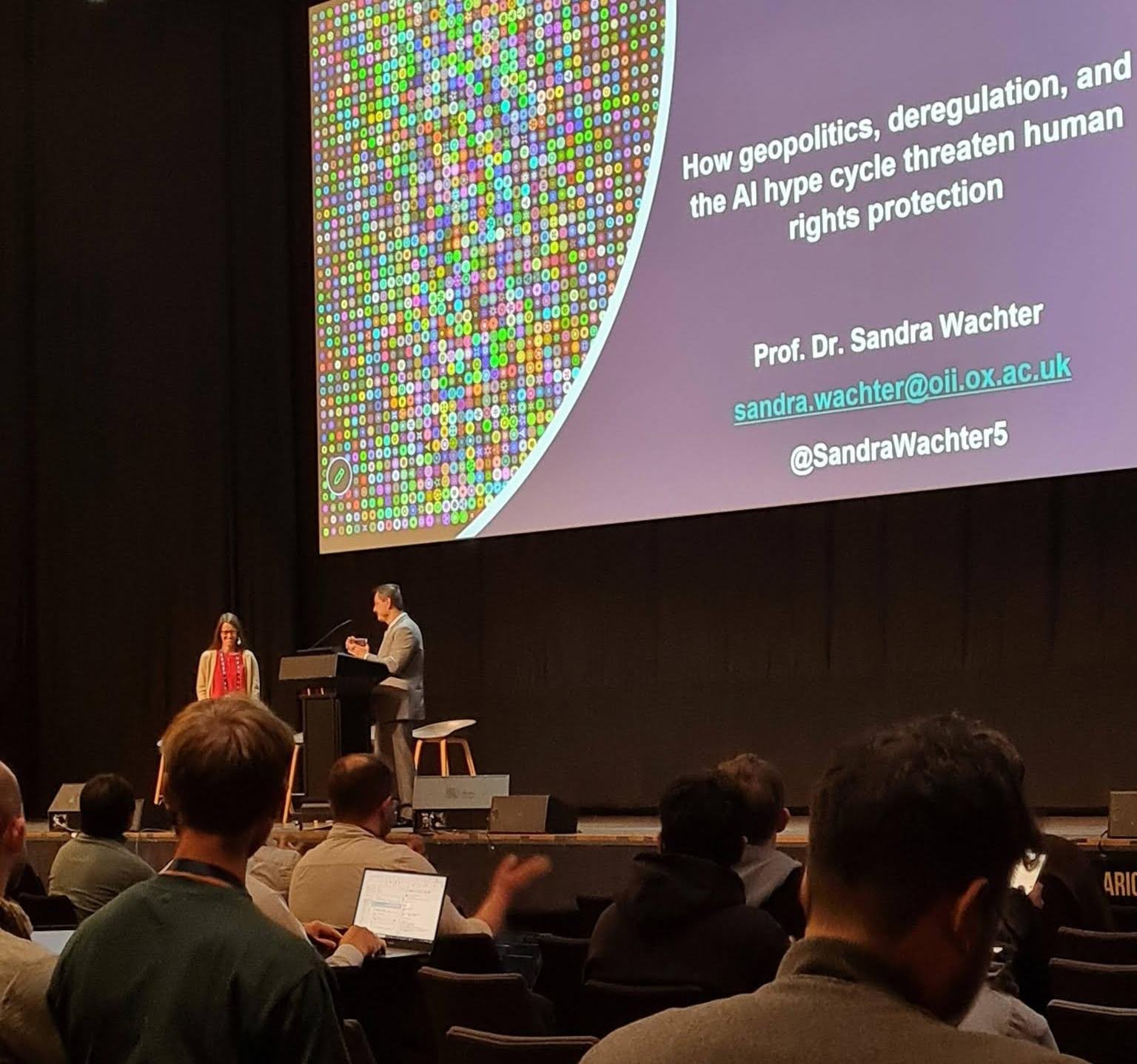
There were many exceptional talks presented throughout this conference. However, Professor Sandra Wachter’s keynote particularly resonated with me. Wachter argued that a political will primarily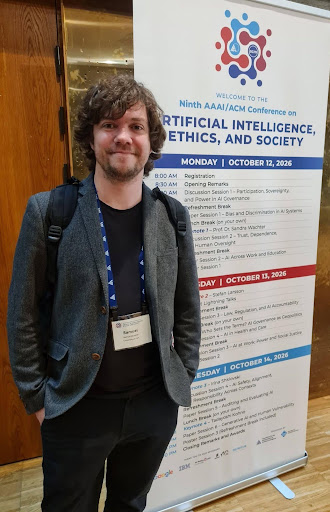 motivated by a desire to increase economic growth and technological competitiveness is currently threatening the general public via incentivising deregulation. This deregulation has led to weakened protection of human rights, data sovereignty, and access to fundamental resources such as land, water, and energy. As Wachter argued, in all but name, the general public should be considered as both investors and shareholders of AI since it is only through the resources we borrow to AI (data, land, energy, etc) that such technologies are enabled. With this in mind, the general public should be considered as entitled for just compensation in the form of socially beneficial technologies – not just technologies which do not pose certain risks of harm.
Professor Tadayoshi Kohno’s keynote also stood out particularly due to the contrastive optimism of the talk compared with many other more pessimistic talks presented throughout the conference. Currently the AI Safety/Ethics community is faced with the daunting challenge of how to adequately safeguard against the unwieldy nature of AI. However, Kohno argued that the field of computer security research has faced similar challenges over the last few decades adapting to new technologies but has largely overcome them. According to Kohno, this fact should alleviate at least some of our worries related to the task of adequately safeguarding ourselves against AI in the future.
 There were many other exceptional papers presented throughout this conference (too many to comment on in full). However, a few have particularly stuck with me. Firstly, there was a paper presented by Pranav Agrawal which highlighted the ludicrous extent to which AI-washing is occurring in various German startups.Furthermore, this talk made me aware of the extremely ethically questionable practise of bio-hybrid cyborg insects being proposed by various companies. Other talks of note covered topics such as how AI-generated summaries can distort human memory and how advertising is starting to be integrated i nto LLM’s such as ChatGPT. I was also happy to hear the capabilities approach (my topic of research) mentioned in passing positively as a philosophical perspective for AI evaluation by Alessandro Facchini during a discussion session on the topic of ‘Trust, Dependence, and Human Oversight’.